

GNT #141: The simple map behind a million-dollar movement
Welcome to Grow North Thursday - One idea each week to help you grow with purpose, earn sustainably, and design a life you love.
Forwarded this? Subscribe here so you never miss an issue.
read time: 4 minutes
Last week, I was on a call with a nonprofit looking to breathe some fresh air into their strategy.
They were curious how CIOs Against Cancer, a community I helped start in 2020, gained traction so quickly.
“You grew a loyal following, raised serious money, and got C-suite leaders to show up - all in just a few years. How’d you do it?”
They were expecting some secret formula.
But the truth is, it came down to just one simple, powerful idea.
Alignment.
When you align the right stakeholders - when everyone involved can clearly see what’s in it for them and for everyone in the broader picture - you unlock something very special.
Momentum.
That’s how a small community initiative became a multi-state movement raising over $2M+ for cancer research in just a few years.
But this concept doesn’t just work for nonprofits. It can help anyone. From Fortune 500s to solo consultants, from local shops to startups - when you learn to align your stakeholders (the people, partners, and audiences connected to your work), growth gets easier.
Because alignment creates clarity. And clarity creates momentum.
In today’s newsletter, you’ll walk away with:
-
The real reason some organizations and people build unstoppable momentum
-
A simple, actionable framework to map the key people around your work and design win/win/win outcomes.
-
How to turn alignment into traction - no matter your size, team, or industry.
Let’s get to it.
The problem: Everyone’s rowing, but in different directions
You know that feeling when you’ve got a great idea that should be growing faster… but it’s not catching?
You’re showing up, doing the right things, and care deeply about the work.
And yet, the energy feels scattered. You’re rowing hard, but the boat’s not moving the way it should.
It’s easy to think that’s a marketing problem or a motivation problem. But more often, it’s an alignment problem. Because when your stakeholders - your team, clients, partners, or community - can’t clearly see how their goals connect to yours, they start paddling in their own direction.
Not out of resistance, out of confusion. And when everyone’s slightly misaligned, even small efforts feel heavy.
The answer isn’t to row harder. It’s to get everyone rowing together.
That’s what alignment does.
The fix: create your stakeholder map
Alignment doesn’t happen by accident. It happens on purpose.
And one of the simplest ways to make it happen is through a stakeholder map.
A stakeholder map helps you see everyone connected to your work, understand what matters to them, and spot the overlaps where shared wins live.
Here’s how to create one.
Step 1: Define what sits at the center
Every stakeholder map starts with a clear center. Write down what your business exists to do, your purpose.
If you’re not sure what that is yet, I’ve got a quick resource to help:
👉 5 Simple Questions to Find Your Business Purpose
Once you’ve got that statement, put it in the middle of your map. Everything else connects to it.
Here's mine:

Step 2: List your stakeholders
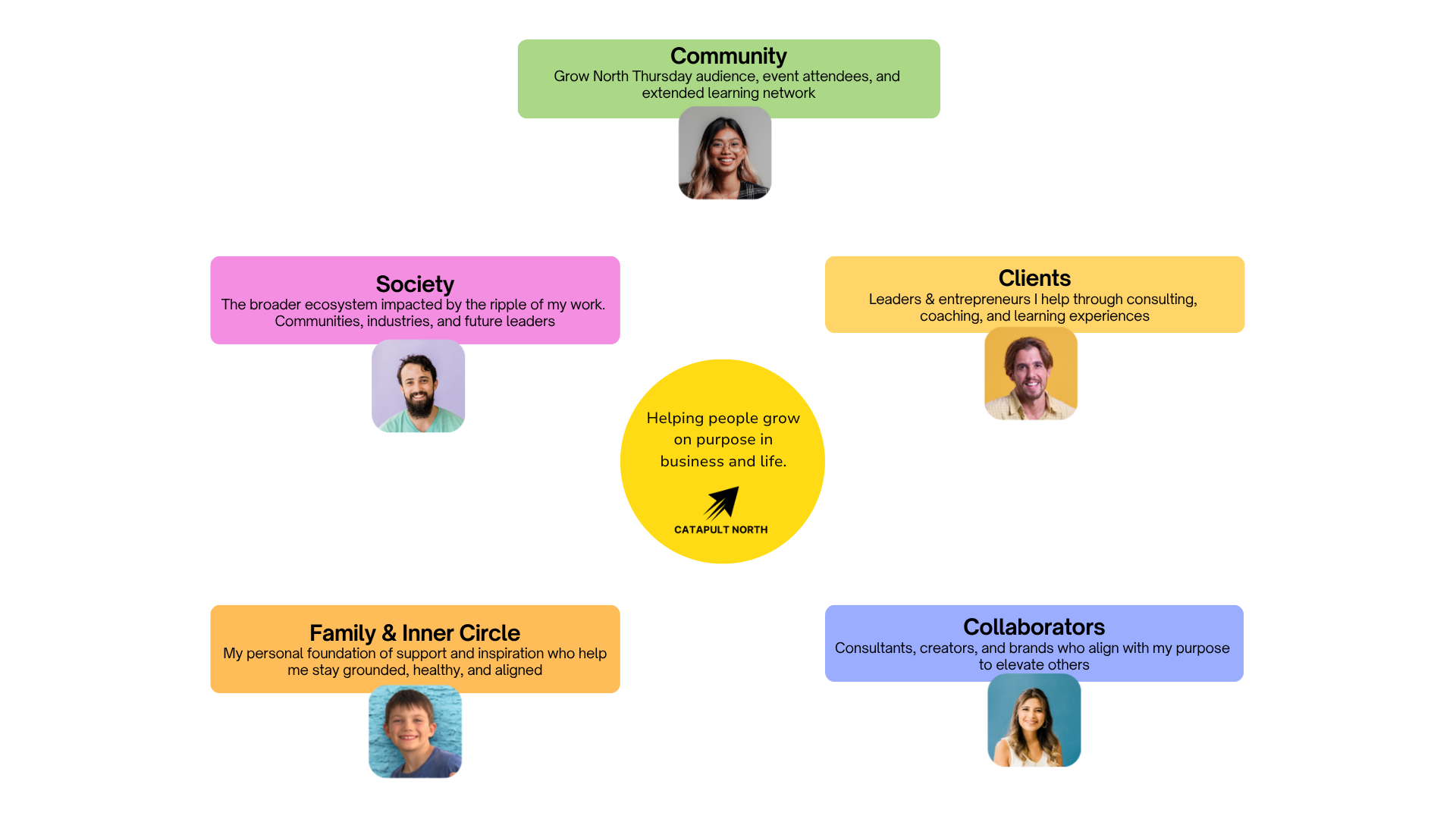
Who’s in your world? Think beyond customers. Include employees, partners, vendors, investors, collaborators, and your broader community.
If you’re a solo consultant, your map might include clients, referral partners, contractors, and your online audience or network.
Ask yourself: Who influences my/our success or is affected by what I/we do?
Here are my stakeholders:
Step 3: Define what winning means for each group
Each stakeholder has their own goals and motivations.
-
Customers want confidence and results.
-
Employees want purpose and growth.
-
Partners want visibility and opportunity.
-
Communities want connection and contribution.
When you understand exactly what success looks like for each, you can design outcomes that benefit everyone.
Here's mine. I review it in my weekly close-out meeting with myself along with the current state of the relationship. This quarter I'm focusing on my collaborators.

Step 3: Look for intersections
The power of a stakeholder map is in the overlap. That’s where shared value lives.
For instance, highlighting other newlsetters I love supports my community, collaborators, and my own purpose.
CIOs Against Cancer events create shared value for CIOs, volunteers, our corporate organizer, sponsors, the American Cancer Society, and our world.
Putting alignment to work
Once you understand your stakeholder map, the next step is to actually use it. Think of it as a lens for how you plan, decide, and communicate.
Every choice can be guided by one simple question:
“Does this create value for more than one stakeholder group?”
CIOs Against Cancer used this lens for everything. From event planning to sponsorships. The programs that stuck were the ones that offered multiple wins for stakeholders:
You can do this at any scale.
A business leader can use their map to guide partnerships and marketing, choosing projects that serve customers + employees + community.
A small business owner can design offers that support clients and collaborators.
A solo consultant can use their map to decide where to spend time.
To keep alignment alive:
-
Lead with shared value. Choose initiatives that lift multiple groups at once.
-
Communicate the “why.” Keep connecting decisions back to the broader why so everyone stays engaged.
-
Listen often. Check in with stakeholders to see what’s working and what needs adjusting.
Takeaway
Alignment creates clarity. Clarity creates movement.
When you understand who’s connected to your work and what matters to them, your efforts start to compound instead of compete.
That’s the difference between pushing growth uphill and being pulled forward by momentum you’ve intentionally designed.
👉 Action for this week:
Sketch your stakeholder map. Identify 3–5 key groups and one way their success connects to yours.
Keep it simple, make it visible.
I'm always rooting for you. See you next week.
📩 If you’ve found value in this newsletter, please forward it on. The greatest thank-you you could give me is to share it with a friend.
Whenever you're ready, there are 3 ways I can help you:
1. Need some team training and a plan to achieve purpose-driven growth? Let me lead a workshop for you. [Contact me here]
2. Want me to come speak at your event or meeting about one of my content topics? [Contact me here]
3. Want short but meaty tips on growth systems for profit, purpose, and a meaningful life? [Follow me on LinkedIn]
If you liked this article, you might also like:
GNT #115: Fulfilling work is more than just happiness
GNT #085: Defining Core Values Can Change Your Life
GNT #084: The Ultimate Purpose-Driven Growth Reading List
If you were forwarded this, sign up to receive it each week here. It’s free. I never spam.
To read my full library of newsletters, click here.